Vienna occupies a useful position for travellers moving between Western, Central and Eastern Europe. A company director may need to visit several regional offices during the same week, while a family leaving Austria for a Mediterranean holiday may prefer to avoid connecting flights and restrictive airline schedules. The Austrian capital provides access to an extensive European aviation network, making it possible to consider individual flight arrangements for journeys that demand greater flexibility. Private charter is particularly relevant when several passengers are travelling together, the destination has limited scheduled connections, or the available airline departures do not fit the intended itinerary.
Organising such a journey begins with the route rather than the aircraft. Passengers exploring private jet charter Vienna (https://rentjet.eu/private-jet-vienna/) options can request flights according to their preferred destination, departure date and number of travellers. The quotation depends on the aircraft available, its operating requirements and the arrangements needed to complete the journey. Choosing an appropriate departure time is only one part of the process, since airport access, luggage capacity and onward connections can have an equally significant effect on convenience.
Vienna’s geographical position also makes it attractive for itineraries involving more than one destination. Business travellers may need to combine meetings in Munich, Zurich and Paris, while leisure passengers could plan journeys towards southern Italy, the Greek islands or Alpine resorts. Private aviation allows these schedules to be considered as a connected itinerary rather than a collection of unrelated airline bookings. Whether the additional flexibility justifies the expense depends on the practical requirements of the travellers and the alternatives available.
Departing from Vienna International Airport
Vienna International Airport, located in Schwechat southeast of the city, serves as Austria’s principal international air transport hub. Alongside its extensive scheduled airline operations, the airport has dedicated facilities for business and private aviation. Its VIP and General Aviation Terminal is situated in the western part of the airport grounds, providing a separate environment for passengers using private aircraft and certain specialist airport services. This arrangement allows charter travellers to avoid the standard airline check-in process while still complying with applicable security and border requirements.
The airport’s general aviation infrastructure supports a range of services associated with private flights. Specialist handling companies coordinate aircraft movements, passenger reception, baggage and access to appropriate ground transport. Depending on the services arranged, passengers may have access to private waiting areas and assistance with departure formalities. The precise facilities should be confirmed in advance, particularly when the group includes children, passengers requiring additional assistance or travellers carrying unusual equipment.
Reaching the airport from central Vienna is generally straightforward, although transfer times depend on the starting address and prevailing traffic. Travellers staying near the historic centre may have different transport requirements from those based in the city’s outer districts or neighbouring towns. A prearranged driver can simplify the transfer, provided the meeting point is correctly identified. Private aviation passengers should receive instructions for the relevant general aviation facility rather than assume they need to enter the main terminal complex.
Airport operating requirements remain an important part of planning. Departure arrangements can be affected by aircraft size, available slots, air traffic conditions and the services required for the flight. Travellers requesting departures outside typical business hours should confirm whether their proposed schedule can be accommodated. A charter provider can coordinate these matters with the aircraft operator and handling agent before the itinerary is finalised.
Vienna International Airport also offers a useful starting point for passengers travelling from areas beyond the capital. Its position within Austria’s road network makes it accessible from parts of Lower Austria and Burgenland, although the total transfer time should be assessed individually. For some journeys, another airport closer to the passenger’s final destination may offer advantages. The decision should consider both ends of the proposed flight rather than focus exclusively on departure from Vienna.
European Destinations and Multi-City Itineraries
One of Vienna’s advantages is its proximity to several important European business centres. Munich, Zurich, Milan and Prague are all relatively close in geographical terms, while London and Paris remain within the operating range of many business jets. These destinations attract passengers travelling for corporate meetings, professional services and international events. Private aviation can be useful when the journey requires a tightly coordinated schedule or when several colleagues need to travel together.
Short distances do not automatically make flying the best option, however. A journey from Vienna to a nearby city may be more practical by train or car once airport transfers and departure procedures are considered. For example, travelling between Vienna and Bratislava rarely provides a compelling reason to charter an aircraft. Private aviation becomes more relevant where the final destination is difficult to reach by surface transport or where the itinerary includes several cities that would otherwise require lengthy connections.
The distinction is particularly important for multi-stop business travel. A management team might need to visit a manufacturing facility in northern Italy before continuing to Switzerland for meetings with investors. Scheduled flights could require separate bookings, connections or overnight stays that do not fit the intended timetable. A private charter may allow the team to travel between suitable airports according to an agreed sequence, subject to airport availability and operational requirements.
Such arrangements must still account for the practical limitations of aircraft operations. Crew duty periods, refuelling requirements, airport opening hours and parking availability can affect how many destinations are feasible within a given period. Passengers should avoid assuming that an aircraft can remain available indefinitely or depart immediately after every meeting. A well-prepared itinerary allows realistic time between appointments and includes suitable alternatives if conditions change.
Leisure travel creates different possibilities. Vienna can serve as a departure point for flights towards the Mediterranean, where passengers may wish to reach islands or coastal destinations with limited direct airline connections. Families travelling to private villas or groups visiting resorts may value the ability to choose departure times and travel together. The availability of suitable arrival airports, particularly at smaller destinations, should be checked before accommodation and ground transfers are finalised.
Selecting an Aircraft That Matches the Journey
The choice of aircraft should reflect the actual requirements of the passengers rather than the prestige associated with a particular model. A short European journey involving three executives does not generally demand the same aircraft as a longer flight carrying a large family and substantial luggage. Passenger numbers, flight distance, baggage requirements and cabin comfort all influence the appropriate category. Airport restrictions may further limit the selection, particularly when the destination has a relatively short runway or specific operating requirements.
Private aircraft are available in several categories, each offering different operational characteristics.
- Light jets can be suitable for smaller groups travelling on relatively short European routes, provided their luggage and cabin requirements are modest.
- Midsize jets offer additional seating space and baggage capacity, making them appropriate for longer journeys or passengers carrying more equipment.
- Super-midsize jets generally provide greater range and more spacious cabins, which can be useful for business groups travelling over longer distances.
- Heavy jets accommodate larger groups and longer international sectors, with cabin configurations that may include separate seating areas and more extensive onboard facilities.
- VIP-configured airliners serve specialised group travel requirements, although their operating costs and airport needs differ considerably from those of conventional business jets.
Individual aircraft specifications matter more than category labels alone. Two jets described as midsize may have different seating configurations, practical ranges and luggage compartments. Aircraft performance also depends on conditions such as passenger load, weather and the characteristics of the departure and arrival airports. The number of seats advertised for a model should therefore not be treated as a guarantee that every possible combination of passengers and baggage can be accommodated.
Cabin facilities require similar scrutiny. Travellers hoping to work during a flight may need reliable connectivity, suitable tables and seating arrangements that allow colleagues to communicate comfortably. Not every aircraft offers the same equipment, and internet access may be subject to geographical or technical limitations. Families may place greater importance on comfortable seating, space for children and appropriate catering arrangements. These requirements should be discussed before the aircraft is selected.
There is little financial benefit in hiring a substantially larger jet when a smaller model can complete the journey comfortably and safely. Equally, choosing the lowest-priced aircraft can be a false economy if the cabin is unsuitable or the baggage capacity inadequate. Passengers should ask why a proposed aircraft has been recommended and whether another category would offer a better balance of cost and practicality. The most appropriate choice is the one that meets the actual needs of the journey without unnecessary expenditure.
Understanding Private Charter Prices from Vienna
Private jet charter prices are calculated according to the operating requirements of an individual flight. Distance and aircraft size play important roles, but the final quotation depends on several additional factors. Airport handling charges, fuel requirements, crew arrangements and the position of the aircraft before departure can all influence the cost. Demand during busy travel periods may also affect availability, particularly when several customers are seeking similar aircraft at short notice.
Aircraft positioning is among the less obvious expenses. If a suitable jet is already located at Vienna International Airport, it may be available without an additional flight to collect the passengers. If the operator must bring the aircraft from another city, the cost of that movement may be included in the quotation. A similar issue arises after the passengers reach their destination, since the aircraft may need to return to its base or travel elsewhere for another booking.
The length of a visit can also influence pricing. A group travelling to Paris for a meeting may prefer to return to Vienna the same evening, while passengers leaving for a fortnight’s holiday will require a different arrangement. Keeping an aircraft and crew at the destination can involve parking, accommodation and other operating expenses. For longer stays, organising separate outbound and return flights may be more economical, depending on aircraft availability and the operator’s schedule.
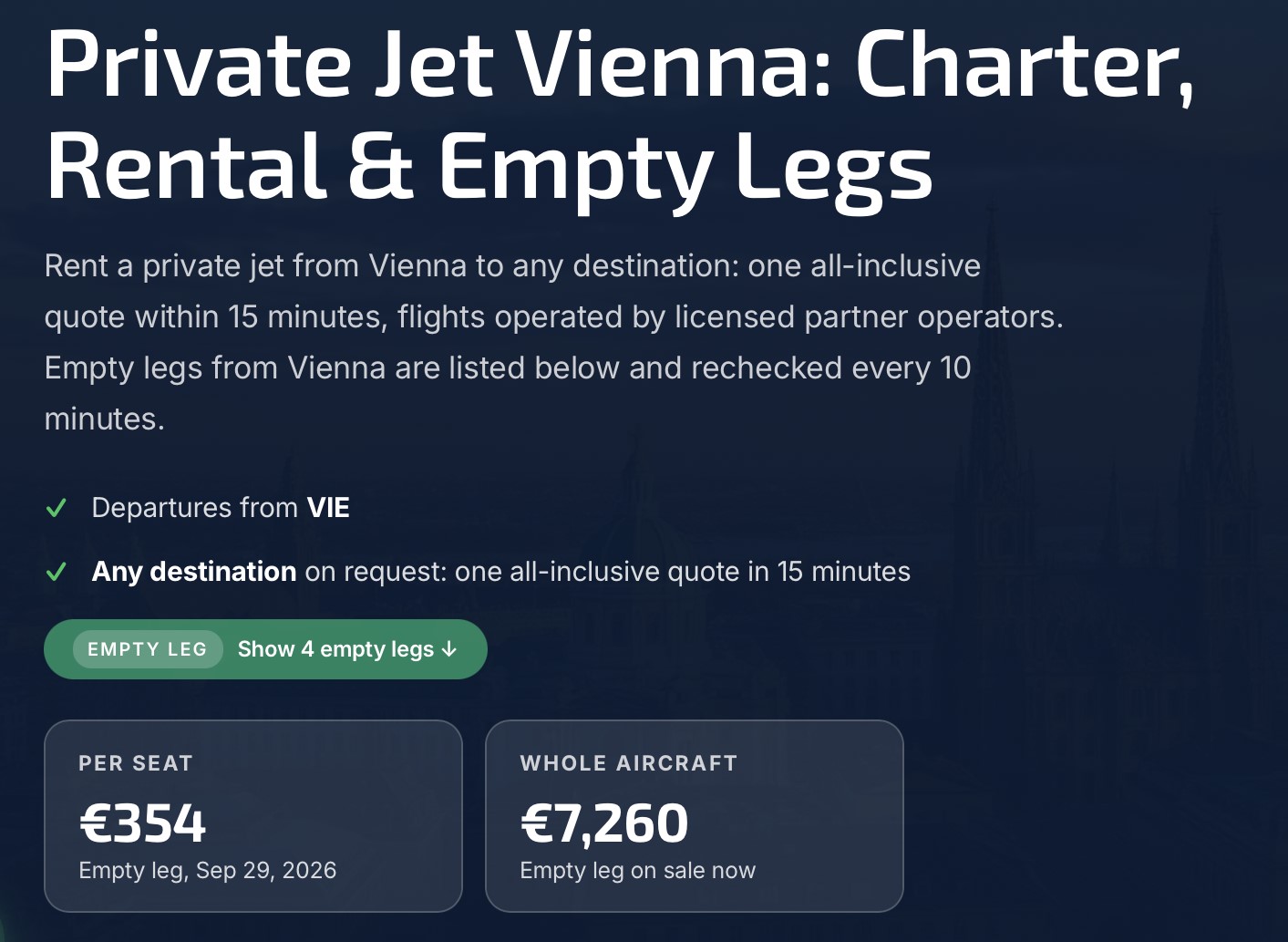
Travellers with flexible plans may consider empty leg flights as an alternative. These opportunities arise when an aircraft must reposition without passengers before or after another charter assignment. Operators sometimes offer the available sector at a reduced price because the flight is already required for operational reasons. However, the route and departure time normally depend on the original booking, and changes to that booking may affect the empty leg. The lower price therefore needs to be weighed against reduced scheduling flexibility and the possibility of disruption.
A quotation should explain the agreed services and identify any costs that may arise from changes to the itinerary. Important details include the aircraft or aircraft category, operating company, airport arrangements, catering, payment terms and cancellation conditions. Passengers should also establish how additional ground transport or special requests will be charged. Comparing complete quotations provides a more reliable basis for choosing a charter than selecting the lowest advertised figure.
Preparing for International Departure
The organisation of a private flight should begin well before passengers arrive at the airport. Accurate travel dates, destination details and passenger numbers allow the charter provider to identify suitable aircraft and prepare an appropriate itinerary. Any unusual luggage, medical mobility equipment, pets or specialist items should be declared during the initial enquiry. This information can affect aircraft selection, handling arrangements and the documentation required for the journey.
International travel formalities remain applicable to private aviation. Flights between Austria and other Schengen countries may involve different border procedures from journeys to the United Kingdom or countries outside the Schengen Area. Passport and visa requirements depend on the passenger’s nationality, residence status and destination. Travellers should verify the conditions relevant to their individual circumstances rather than assume that using a private terminal removes immigration obligations.
Several practical details should be confirmed before departure, including the terminal location, recommended arrival time and contact arrangements for the ground transport provider. Private terminals can offer more individualised handling than standard airline facilities, but the precise procedures depend on the airport and operator. Travellers should follow the instructions provided for their specific flight rather than rely on general descriptions of private aviation. This is particularly important for groups arriving separately or passengers unfamiliar with Vienna Airport.
Weather and air traffic conditions must also be considered. Poor visibility, thunderstorms or restrictions at the destination can require adjustments to the planned itinerary. A private charter provides greater control over scheduling, but the captain and operator remain responsible for compliance with aviation regulations and safe operating procedures. Passengers should allow reasonable flexibility where an important appointment or onward connection depends on punctual arrival.
For some journeys, commercial airlines or rail services will remain the more practical choice. Vienna has extensive scheduled transport connections, and an individual passenger travelling between major European cities may gain little from hiring an entire aircraft. A charter becomes more compelling when several people need to travel together, when the itinerary includes multiple destinations or when available transport schedules create costly interruptions. The decision should reflect the complete cost and convenience of the journey rather than assumptions about private aviation.
Vienna’s position in Central Europe makes it a useful departure point for carefully planned international travel. Its dedicated general aviation facilities, access to a range of aircraft and connections to European destinations provide considerable scope for individual itineraries. The strongest arrangements begin with a clear understanding of the route, passenger requirements and practical alternatives. When these factors are considered together, a private charter can serve as an effective transport solution rather than simply a more expensive way to fly.